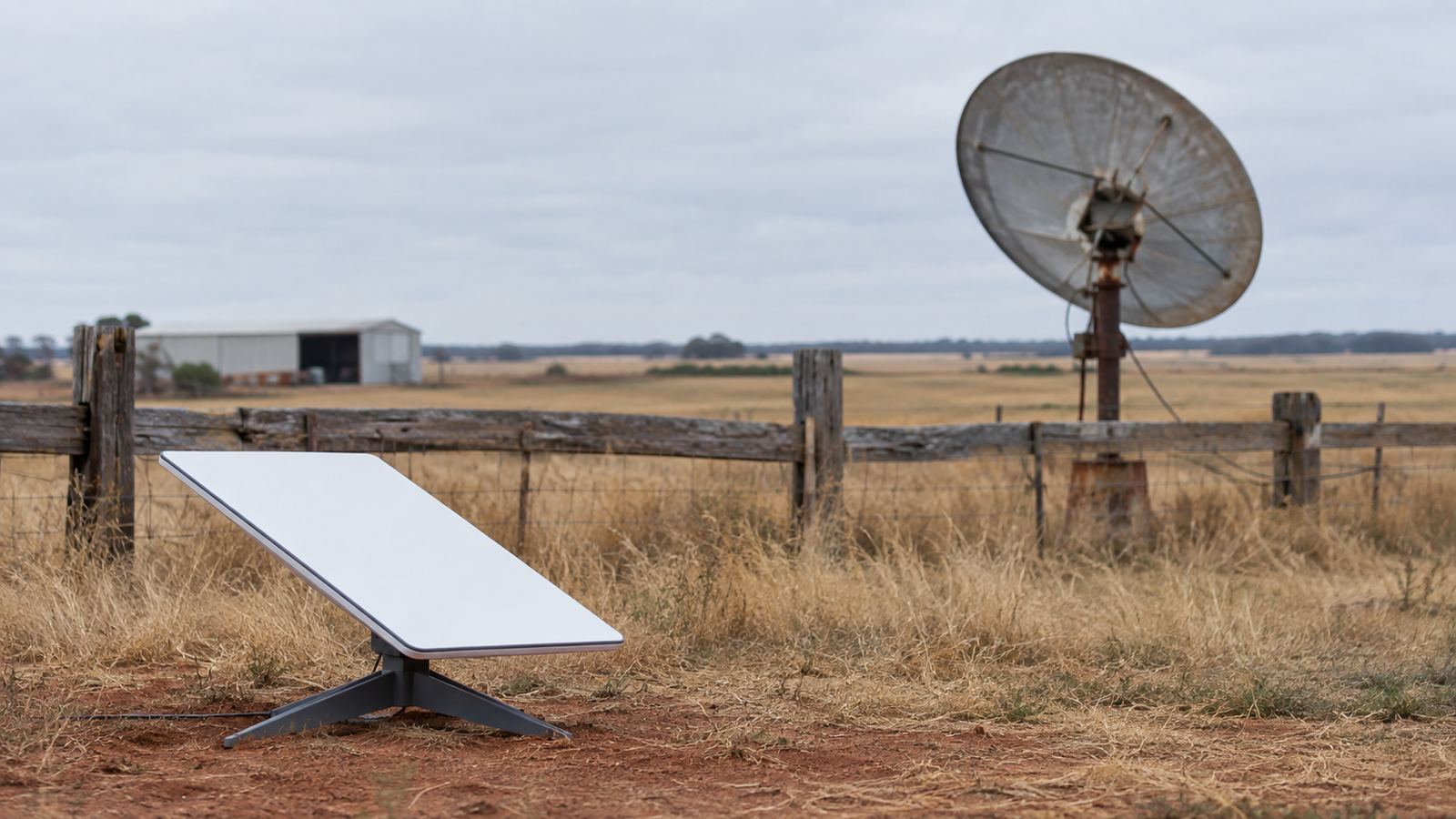
If you can get fixed-line NBN, take it. Nothing below changes that.
This page is for the other case: you are outside the fixed-line footprint and choosing between Starlink, NBN fixed wireless and NBN Sky Muster. All 3 are measured by the ACCC in the same report, which makes this one of the few comparisons in Australian broadband you can settle with evidence rather than opinion.
The problem with every comparison table you will find
The ACCC reports NBN services as a percentage of the plan speed you bought, and Starlink as an absolute number of megabits.
That is a sensible choice, because NBN sells you a 50 Mbps plan and the useful question is whether you get 50, while Starlink Residential Max is uncapped and the useful question is what it delivers. But it means the two figures are not the same kind of thing.
Nearly every published comparison puts “89.7% of plan” and “230 Mbps” in the same column anyway. Those numbers cannot be compared. A fixed wireless service delivering 89.7% of a 50 Mbps plan is delivering about 45 Mbps, which is a very different sentence from the one the table implies.
So this page separates what is genuinely comparable from what is not.
What each service delivers on its own terms
All figures from the ACCC’s Measuring Broadband Australia Report 33, measurements taken 1 to 31 March 2026.
| Starlink | NBN fixed wireless | NBN Sky Muster | |
|---|---|---|---|
| Download, all hours | 230.4 Mbps (Residential Max) | 89.7% of plan | 89.0% of plan |
| Download, busy hours | 199.1 Mbps (Residential Max) | 83.8% of plan | 78.5% of plan |
| Upload, all hours | 47.5 Mbps | 70.1% of plan | 119.1% of plan |
| Upload, busy hours | 45.5 Mbps | 63.7% of plan | 111.7% of plan |
| Panel size | 48 units | 153 units | 46 units |
2 things in that table deserve more attention than they usually get.
Starlink’s figure is a Residential Max figure. The ACCC states that its download and upload results cover only services on the Residential Max plan, which is the $150 a month uncapped tier. On Residential 100 at $75 you are capped at 100 Mbps by the plan. Anyone quoting 230 Mbps as “Starlink’s speed” without that qualification is describing the most expensive plan.
Sky Muster over-delivers on upload. 119.1% of plan speed across all hours, and 111.7% in the evening peak. It is the only one of the three that beats what it sold you, and it deserves the credit. The ceiling is just low.
What is genuinely comparable: latency
Latency is where the argument ends, and it is not close. These are the ACCC’s measured figures.
| Service | Average latency |
|---|---|
| Starlink | 29.8 ms |
| NBN fixed wireless | 41.7 ms all hours, 43.5 ms busy |
| NBN Sky Muster | 664.9 ms |
Starlink and fixed wireless are both in normal-internet territory. Sky Muster is 22 times higher than Starlink, and that is physics rather than a tuning problem: its satellites are geostationary, roughly 36,000 km up, so every request makes that round trip. Starlink’s are a few hundred kilometres up.
In practice, 664.9 ms is what makes a video call feel like a walkie-talkie conversation. It is the single strongest reason people leave Sky Muster.
What is also comparable, and gets reported wrongly: outages
The ACCC counts outages the same way for all three services, so this is a fair fight. It is also where the received wisdom is out of date.
How often units drop out:
| No outages at all | At most every other day | Most days | At least daily | |
|---|---|---|---|---|
| Starlink | 35.3% | 62.7% | 0.0% | 2.0% |
| NBN fixed wireless | 34.0% | 59.5% | 4.6% | 2.0% |
| NBN Sky Muster | 0.0% | 65.2% | 15.2% | 19.6% |
Starlink and fixed wireless are within about a percentage point of each other. Not one Sky Muster unit in the panel went a whole month without an outage.
How long those outages last, which matters more:
| 30 to 60 sec | 1 to 3 min | 3 to 10 min | 10 min or more | |
|---|---|---|---|---|
| Starlink | 71.7% | 19.3% | 7.0% | 2.0% |
| NBN fixed wireless | 25.2% | 37.5% | 16.2% | 21.1% |
| NBN Sky Muster | 25.8% | 38.2% | 26.8% | 9.2% |
This is the finding worth taking away. Starlink and fixed wireless drop out about as often as each other, but when Starlink drops out it is back inside a minute 71.7% of the time, against 25.2% for fixed wireless. And 21.1% of fixed wireless outages run past 10 minutes, against 2.0% of Starlink’s.
That is a tenfold difference on the outages that actually ruin your afternoon. The widely repeated line that fixed wireless is the more reliable of the two is describing outage frequency, which is a wash, and skipping duration, which is not.
So which should you get?
Taking the ACCC figures above together, the answer differs by what you can actually get.
If fixed-line NBN reaches your address, take it. Cheaper and faster than everything on this page.
If you can get NBN fixed wireless, it is genuinely competitive and worth pricing up. It usually costs less than Starlink, installation of the antenna is normally included, and on speed it delivers most of what it sells. Accept that when it goes down it tends to stay down longer.
If your only NBN option is Sky Muster, Starlink is a different category of connection rather than a faster version of the same one. 29.8 ms against 664.9 ms, and an outage profile that is better on every measure. The counterweight is cost: Sky Muster’s dish and installation are provided, where Starlink hardware is an upfront purchase, which we break down on our Starlink cost page.
If you move around, none of the NBN options travel. That is Roam’s entire reason to exist, and we cover it on our Starlink plans page.
One thing to factor in before you commit
nbn is replacing Sky Muster with nbn LEO, powered by Amazon Leo, offering uncapped data at wholesale speeds of up to 50/10 and 100/20 Mbps. nbn says eligible customers can expect to begin transitioning from around mid-2027.
That is a low-orbit service, so the 664.9 ms latency problem goes away with it. If you are on Sky Muster and can tolerate it for another year or so, waiting is a legitimate option. If you cannot, Starlink is available now and there is a 30-day trial with a full refund if it does not work at your address.
Worth being realistic about the timing, though. That rollout has already slipped once, from late 2026 to mid-2027.
What we see on our own kits
We hire Starlink Mini kits across Western Australia, so these are real deployments rather than a test panel: 180 Mbps at Esperance in summer 2025-26 and 175 Mbps at Exmouth in July 2026, both measured in the Starlink app by the people using them. Across the fleet the range is 100 to 200 Mbps down, 10 to 20 up, and 20 to 40 ms.
Those are Mini kits on a mobile plan sitting on the ground at campsites, not roof-mounted hardware on the top home plan, which is the useful comparison to the ACCC’s 230.4 Mbps on Residential Max. More detail is on our Starlink speeds page.
Questions people ask
Is Starlink better than NBN? Better than Sky Muster on every measure the ACCC publishes. Roughly matched with fixed wireless on speed and outage frequency, clearly better on outage duration and latency. Worse value than fixed-line NBN.
Is Starlink faster than Sky Muster? Yes, and the gap that matters most is latency: 29.8 ms against 664.9 ms.
Can I get Starlink if NBN says I can only have Sky Muster? Yes. Starlink availability depends on a clear view of the sky, not on what NBN has assigned your address.
Is NBN fixed wireless more reliable than Starlink? It drops out about as often. Its outages last longer, with 21.1% running past 10 minutes against Starlink’s 2.0%.
Should I wait for nbn LEO? If Sky Muster is bearable for another year, possibly. Transitions are expected from around mid-2027 and the schedule has already moved once.
Do I have to give the Starlink hardware back? No, you buy it. Sky Muster’s dish is nbn’s and stays with the property, which is a genuine advantage of theirs.
Before you decide
Check what NBN can actually offer your address first, because if fixed-line or fixed wireless is available it will usually be cheaper. If Sky Muster is the answer you get back, check Starlink’s price at your address and use the 30-day trial. If you want to try satellite before buying anything, we hire kits out of Perth.