Airliners Adopt Starlink to Provide Free On-Flight WiFi

In short
Major airlines are shifting to Starlink for fast, free WiFi across long‑haul routes.
Low Earth orbit satellites cut latency so passengers can stream, work, and join video calls.
Emirates is building the largest Starlink‑equipped wide‑body fleet on Boeing 777 and Airbus A380 jets.
Carriers like Qatar Airways, British Airways, WestJet and United Airlines are running similar rollouts.
Competition from OneWeb and Amazon Project Kuiper is pushing in‑flight connectivity quality higher.
Free high‑speed WiFi at 35,000 feet is quickly turning from a nice surprise into a basic expectation. Business travellers want uninterrupted access to Slack and Teams, families want Netflix running quietly on tablets, and younger passengers expect to scroll TikTok or join video calls without thinking about data caps. That pressure is exactly why big carriers are moving their in‑flight networks over to Starlink.
Built by SpaceX, Starlink uses thousands of low Earth orbit satellites to deliver low‑latency broadband directly to each aircraft. Instead of the buffering and dropouts common with older systems, passengers get internet that feels surprisingly close to home fibre. Airlines see this as a strategic move: they keep customers loyal, sell their product as more productive, and get better data channels for operations on every flight.
Across the industry, this shift is no longer theoretical. Emirates is rolling out Starlink across its global wide‑body fleet, Qatar Airways and British Airways are lining up similar upgrades, and North American players like WestJet are touting free WiFi across single‑aisle and wide‑body jets. The race to offer the best in‑flight connectivity is on, and the winners will be the passengers who can finally treat long flights as fully connected time.
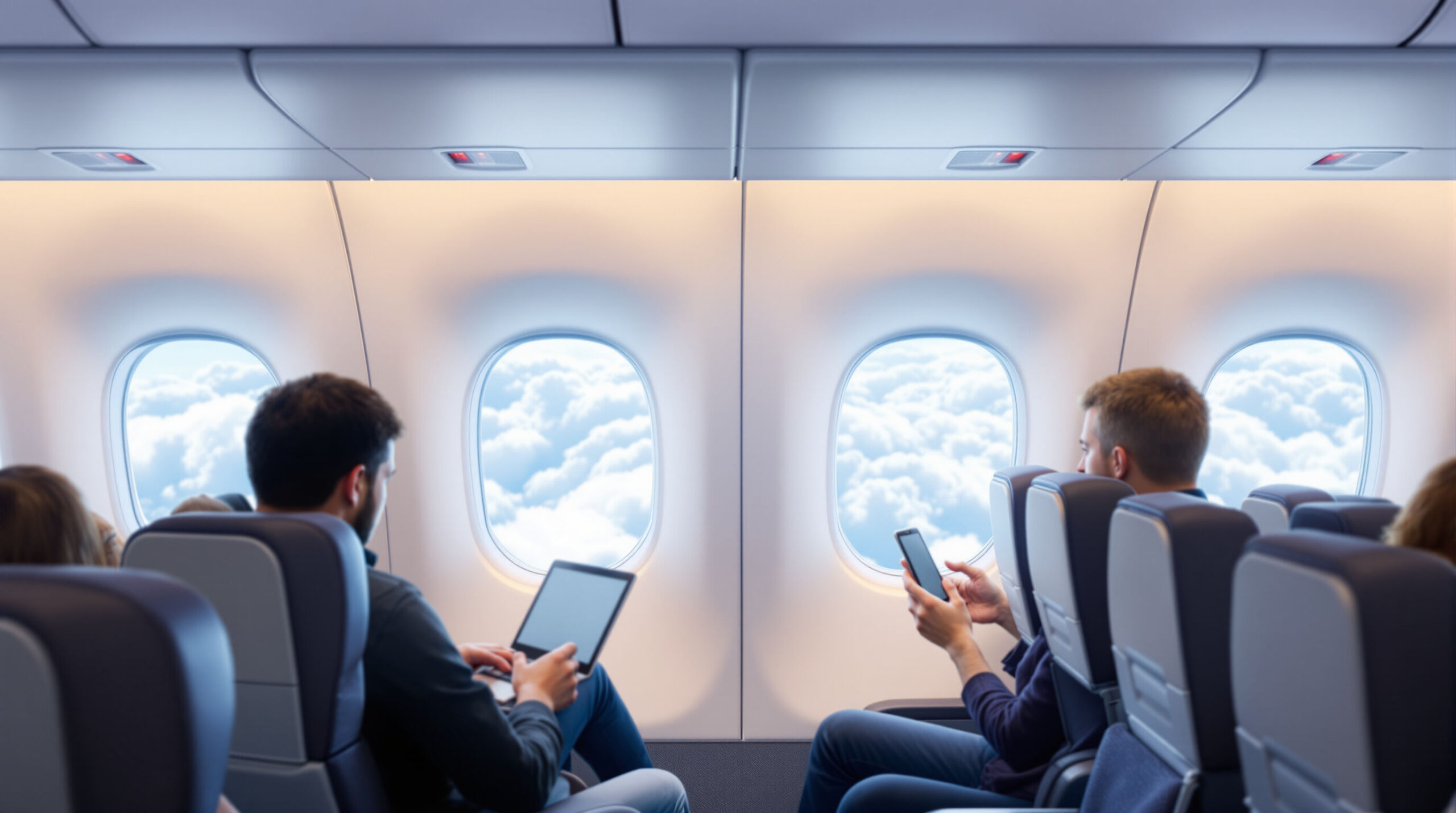
Why Major Airliners Are Switching to Starlink for Free In-Flight WiFi
Overcoming Traditional Challenges of In-Flight Connectivity with Starlink
Legacy in‑flight systems relied on a mix of ground towers and a handful of geostationary satellites. That meant patchy connectivity over oceans, cramped bandwidth for a full cabin, and prices so high that many passengers simply ignored the portal. Speeds often sank below 5 Mbps for an entire aircraft, with latency that made simple video calls almost impossible.
Starlink flips that model. Instead of a few big satellites far from Earth, SpaceX operates a huge mesh of small satellites closer to the planet, trimming latency and spreading capacity. As outlined in guides like this overview of Starlink satellite internet, single users can see tens to hundreds of Mbps at ground level. Onboard, airlines configure the system so an entire cabin can share that bandwidth without collapsing under load.
To put the shift into perspective, look at the core differences between older solutions and Starlink based in‑flight connectivity:
Feature | Traditional in‑flight internet | Starlink in‑flight internet |
|---|---|---|
Satellite orbit | Geostationary, very high altitude | Low Earth orbit constellation |
Typical latency | 600+ ms | Approx. 20‑60 ms |
Practical use | Email, basic browsing only | Work apps, streaming, gaming, video calls |
Coverage over oceans | Patchy or throttled | Continuous global coverage |
For airlines, that performance lets them confidently advertise free WiFi rather than charge high fees for a weak product. Articles like this coverage of free high‑speed Starlink WiFi show how quickly carriers are leaning into the marketing edge.
Lower latency makes cloud tools and messaging feel instant.
Higher throughput supports dozens of concurrent streams on one aircraft.
Global coverage removes the old “no service over water” disclaimer.
The net result is simple: Starlink solves the reliability problem that held in‑flight connectivity back for years.
How Starlink’s Low Earth Orbit Satellites Revolutionize Onboard Internet
Passengers sometimes assume all satellite services are the same. They are not. The low‑orbit design is what lets Starlink feel close to home broadband. Signals travel a far shorter round trip, which is why latency can drop under 50 ms, good enough for cloud gaming and responsive video calls.
The network is still growing. Launch reports such as coverage of Falcon 9 launches adding Starlink satellites show how SpaceX keeps adding capacity and resilience. For airlines, every new satellite strengthens the mesh their fleet depends on.
From a passenger perspective, that matters less than a simple question: does it work like normal? In most test flights, people can stream HD video, sync large presentations, and join team meetings mid‑Atlantic. For frequent flyers who used to schedule around “offline time”, that changes how they use long‑haul trips.
As newer hardware like the upcoming Starlink V3 dishes is discussed in pieces such as the Starlink V3 internet update, the direction is clear: more bandwidth, smarter antennas, better resilience. Airlines see that roadmap and plan multi‑year installation programs around it.
Low Earth orbit keeps latency low enough for live collaboration tools.
Scalable satellite count lets Starlink grow with demand from large fleets.
The technical shift is invisible to most travellers, but they feel it every time a cloud app loads instantly instead of timing out.
Passenger Expectations Driving the Shift to High-Speed Free WiFi on Flights
The trigger for this whole change is behavioural, not technical. People live online, and that does not stop at the jet bridge. Business travellers want every hour paid for, remote workers do not want to burn a day of productivity, and leisure passengers often judge an airline by how easy it is to keep kids entertained on long segments.
That is why more carriers frame Starlink as a service included for everyone, not just premium cabins. WestJet, for example, is focusing on free access branding across its fleet, as covered in pieces such as this report on another airline’s Starlink deal. The message is simple: board any jet, open your device, connect.
For airlines, meeting those expectations is now tied to customer satisfaction scores. When surveys show WiFi quality ranking next to seat comfort and cabin crew service, it becomes a boardroom topic, not just an IT line item.
Free WiFi reduces friction and support queries at the portal stage.
Consistent connectivity across the fleet makes brand promises easier to keep.
Put simply, offering Starlink is less about tech bragging rights and more about matching how people actually live and work.
Comparing Starlink’s Performance to Conventional In-Flight Internet Services
When you compare Starlink to older in‑flight solutions, three angles matter: speed, latency, and reliability. Passengers might not quote numbers, but they know if Teams drops out or Netflix buffers every minute. A modern Starlink setup on a wide‑body aircraft can deliver enough capacity for a full cabin to stay logged in without meltdown.
At ground level, articles such as this discussion of how weather affects Starlink speeds explain how rain or snow can reduce throughput slightly but rarely kill the link. In the air, operators factor this into antenna placement and redundancy. The more important metric up there is how predictable the service feels gate to gate.
Metric | Older satellite systems | Starlink based systems |
|---|---|---|
Average cabin speed | Single‑digit Mbps shared | Tens of Mbps or more shared |
Typical latency | High, poor for real‑time apps | Low, suitable for calls & collaboration |
Passenger satisfaction | Frequent complaints | Closer to home broadband feel |
Competing satellite offerings are improving, but the sheer scale of the Starlink constellation and the pace of launches give it a strong head start for in‑flight connectivity. That is exactly why global carriers are signing multi‑year deals rather than waiting on slower upgrades from legacy providers.
More satellites equal fewer dead zones and better hand‑offs mid‑flight.
Modern hardware allows smoother installation across diverse fleet types.
From the passenger’s point of view, the key comparison is easy: if WiFi lets them forget they are on a plane, the airline wins.
Leading Airlines Implementing Starlink to Enhance Passenger Connectivity
Emirates’ Ambitious Starlink Rollout Across Boeing 777 and Airbus A380 Fleets
Emirates has become the headline case study for aviation’s shift to Starlink. At the Dubai Airshow, the carrier announced plans to fit 232 aircraft – its entire wide‑body fleet of Boeing 777 and Airbus A380 jets – with ultra‑fast, free WiFi using multiple Starlink antenna arrays. The official media release on “gaining speed at 40,000 feet” from Emirates’ press centre sets out the scale clearly.
What stands out is how Emirates couples Starlink with a broader customer experience overhaul. Multiple antennas per aircraft add capacity so full cabins can be online at once. The carrier expects the first commercial Boeing 777 to go live with the system as highlighted in local coverage like this article on the first Starlink flight.
Reports such as this breakdown of the Emirates Starlink announcement and coverage from Gulf News highlight how Sir Tim Clark positions connectivity on the same level as seats and catering. It is a clear signal to competitors that the bar for in‑flight connectivity has moved.
Largest Starlink‑equipped international wide‑body fleet announced to date.
Multiple antennas per aircraft to support dense cabins and premium cabins alike.
As these installations spread from the first Boeing 777 to the full fleet, passengers will start to treat free WiFi on Emirates as something guaranteed, not a lucky bonus.
United Airlines, Qatar Airways, and Other Carriers Adopting Starlink WiFi
Emirates is not alone. Global carriers from the Gulf to Europe and North America are building similar upgrade paths. Qatar Airways, British Airways, Hawaiian Airlines, Alaska Airlines, WestJet, JetBlue and others have all been linked to Starlink rollouts or trials, with varying timelines and aircraft types in scope.
In North America, WestJet and United Airlines see in‑flight connectivity as a differentiator on busy domestic and transborder routes. Coverage like this feature on Starlink WiFi launches makes it clear that travellers now compare WiFi as much as they compare legroom when choosing between carriers.
Airline | Starlink adoption status | Key benefit for passengers |
|---|---|---|
Qatar Airways | Rolling out across long‑haul fleet | More consistent service over oceanic routes |
British Airways | Integrating on select wide‑bodies | Better connectivity for business travellers |
WestJet | Free WiFi push across narrow‑body jets | Inclusive WiFi on popular leisure routes |
United Airlines | Deploying on targeted aircraft | Stronger product for road warriors |
For each of these brands, Starlink is a way to align their tech story with what premium and economy passengers actually want: simple, reliable, and ideally free connectivity. The details vary, but the direction is common across regions.
Gulf carriers focus on ultra‑long‑haul fleet types first.
North American and European airlines phase in narrow‑bodies serving key business routes.
As more routes go live, travellers will begin to select flights based on which tail number has Starlink installed.
Fleet Coverage, Installation Timelines, and User Experience Highlights
Rolling out Starlink across hundreds of jets is not a weekend project. Each aircraft needs structural work, cabling, cabin access points, and integrated software with the airline’s systems. Guides such as the Starlink antenna installation guide give a sense of what is involved even for a home user; scale that up to an A380 and the effort becomes clear.
Most airlines handle this by combining installation windows with heavy maintenance checks. That limits downtime and lets them steadily grow Starlink coverage across the fleet over a couple of years, as described in local press like this piece on Emirates’ two‑year rollout.
For the user, the process is straightforward: connect to the onboard WiFi network, accept terms, and you are online. No need to enter a frequent flyer number or credit card. Chad Gibbs, a senior Starlink leader for commercial aviation, has stressed in public comments that simplified onboarding is central to the product design.
Step‑wise rollout reduces the risk of disruptions during installation.
Passengers see an easy, almost invisible upgrade to their routine.
The best sign that airlines are getting this right is when travellers forget the login page entirely and just treat the plane as another WiFi zone.
Free Access and Seamless Connectivity Across All Cabin Classes Explained
One of the strongest signals from carriers like Emirates, Qatar Airways, British Airways and WestJet is the move to make Starlink access free for all passengers, not only in premium cabins. That shift has a cost, but the payback comes via loyalty, corporate contracts, and better satisfaction scores.
Coverage such as this analysis of Emirates’ Starlink fleet rollout and articles in regional media explain how the airline frames free WiFi as part of a “connected customer journey”. Once you sit down, your device just works, whether you are at the front or the back of the aircraft.
That inclusiveness matters. It tells younger travellers and cost‑sensitive customers that they are part of the digital strategy, not an afterthought. Over time, airlines may refine tiers, but the direction is firmly toward keeping the basic connection free and easy.
Simple access models cut frustration at the login portal.
Universal WiFi supports new digital services like live menus or shopping.
As more fleets complete their installation programs, the idea of paying steep prices for a weak signal will feel dated fast.
The Competitive Landscape and Future Outlook of In-Flight Satellite Internet
Alternatives to Starlink: OneWeb, Project Kuiper, and Other Satellite Providers
Starlink is not the only satellite network chasing airline contracts. OneWeb has partnered with several carriers, and Amazon is pushing its Project Kuiper constellation into the market. Articles like this look at Amazon challenging Starlink in Europe show how intense the rivalry is becoming.
Different airlines make different bets. Some prefer a mix of providers based on route structure and regulatory issues, which are described in resources such as this overview of Starlink’s expansion hurdles. For travellers, this competition is healthy, because it keeps pressure on price and performance.
Provider | Key focus for airlines | Notable strength |
|---|---|---|
Starlink by SpaceX | Global coverage, high bandwidth | Large active constellation already in orbit |
OneWeb | Partner ecosystems, regional deals | Backed by telecom players |
Project Kuiper by Amazon | Upcoming hybrid services | Integration with Amazon Web Services |
In this mix, airlines pick the satellite partner that best matches their timeline, regulatory environment, and service ambitions. Right now, Starlink stands out for sheer availability and proven in‑flight performance.
Multiple providers help airlines avoid lock‑in.
Rivalry pushes all players to improve in‑flight connectivity quality.
For passengers, the most visible side effect will be faster rollouts and fewer excuses for weak WiFi.
Why Some Airlines Choose Different Satellite Services Based on Regional Needs
Not every carrier flies the same network, which is why some mix or even avoid Starlink. Regional regulation, orbital slots, and ground gateway locations influence coverage and latency. In some markets, established players still offer the best regulatory fit, even if their tech lags a bit.
Articles like this discussion of Starlink satellite congestion remind us that large constellations raise policy questions. Airlines with strong national ties sometimes prefer suppliers that align with local political priorities, even if that means giving up some technical advantage.
For now, this means we will see a patchwork: some aircraft with Starlink, some with OneWeb, some still on legacy services. Over the next decade, that patchwork is likely to simplify as next‑generation constellations mature and airlines renew long‑term contracts.
Regional needs may justify non‑Starlink choices on certain fleets.
Passengers benefit as all providers race to close gaps in coverage.
The end goal is the same everywhere: a cabin that feels fully online, no matter which satellite name sits in the fine print.
How Starlink is Transforming In-Flight Entertainment and Business Productivity
Once connectivity is fast and stable, airlines can rethink the entire in‑flight experience. Seat‑back screens can pull content live instead of relying only on cached libraries. BYOD entertainment becomes more attractive as passengers use their own apps, playlists and cloud gaming services over Starlink.
For business travellers, the shift is just as big. Continuous VPN access, real‑time collaboration, and cloud storage syncs turn long flights into genuine work sessions instead of offline gaps. That is exactly the behaviour airlines want to sell to corporate travel managers deciding between carriers.
As more carriers advertise these benefits, being “offline” on a flight will feel like a special choice, not a forced state. For many, the cabin turns into a moving office and living room powered quietly by Starlink satellites overhead.
IFE systems can blend local content with cloud‑based experiences.
Work routines stay consistent regardless of route length.
In short, strong in‑flight connectivity lets airlines turn flight time into useful time, which is valuable for both leisure and business customers.
Strategic Importance of Upgrading Connectivity: Insights from Airlines and Starlink
Leaders at carriers like Emirates, Qatar Airways, British Airways and WestJet keep coming back to the same theme: connectivity is now part of the core product, not an add‑on. Sir Tim Clark has pointed out that modern travellers expect aircraft to feel like “extensions of their digital lives,” and Starlink is how the airline meets that expectation across its fleet.
From the Starlink side, executives such as Chad Gibbs talk about aviation as a flagship use case for the network alongside rural broadband, as covered in resources like this profile of Elon Musk’s Starlink strategy at SpaceX. The message is that aircraft, ships and remote sites all benefit from the same underlying infrastructure.
As more of the global fleet goes online with Starlink and rival constellations, passengers will come to expect a simple truth: if they can see land or sea from the window, they should have a strong signal too.
Connectivity upgrades now sit in long‑term fleet and product plans.
Starlink’s growth path with SpaceX gives airlines confidence to commit.
The quiet winner is the traveller who can finally treat hours in the sky as fully connected time, no matter which logo is on the tail.

How fast is Starlink WiFi on commercial flights?
Exact numbers vary by airline and aircraft, but Starlink typically delivers speeds that allow passengers to browse, stream HD video, use cloud tools and handle video calls. Latency is much lower than older satellite systems, so the connection feels far closer to home broadband than traditional in-flight internet.
Is Starlink WiFi really free for all passengers?
On many airlines adopting Starlink, including big names like Emirates and WestJet, the core WiFi service is offered free to all passengers across cabins. Some may add premium tiers for heavier usage, but basic messaging and browsing access is increasingly included in the ticket price.
Which airlines are rolling out Starlink right now?
Emirates is one of the most visible, fitting Starlink across its Boeing 777 and Airbus A380 fleet. Other carriers such as Qatar Airways, British Airways, WestJet, United Airlines, Hawaiian Airlines and Alaska Airlines have started or announced rollouts, with more expected to follow.
Can I make video calls using Starlink on a plane?
From a technical standpoint, Starlink can comfortably support video calls thanks to low latency and decent bandwidth. Airlines still control what is allowed on their networks, so some may restrict calls for cabin comfort, but the underlying connection is strong enough to support them.
Does bad weather affect Starlink during a flight?
Heavy rain or snow can slightly affect any satellite signal, but in practice Starlink is engineered to maintain stable connectivity. Airlines use multiple antennas and careful installation on each aircraft, so passengers usually see only minor slowdowns rather than full dropouts.