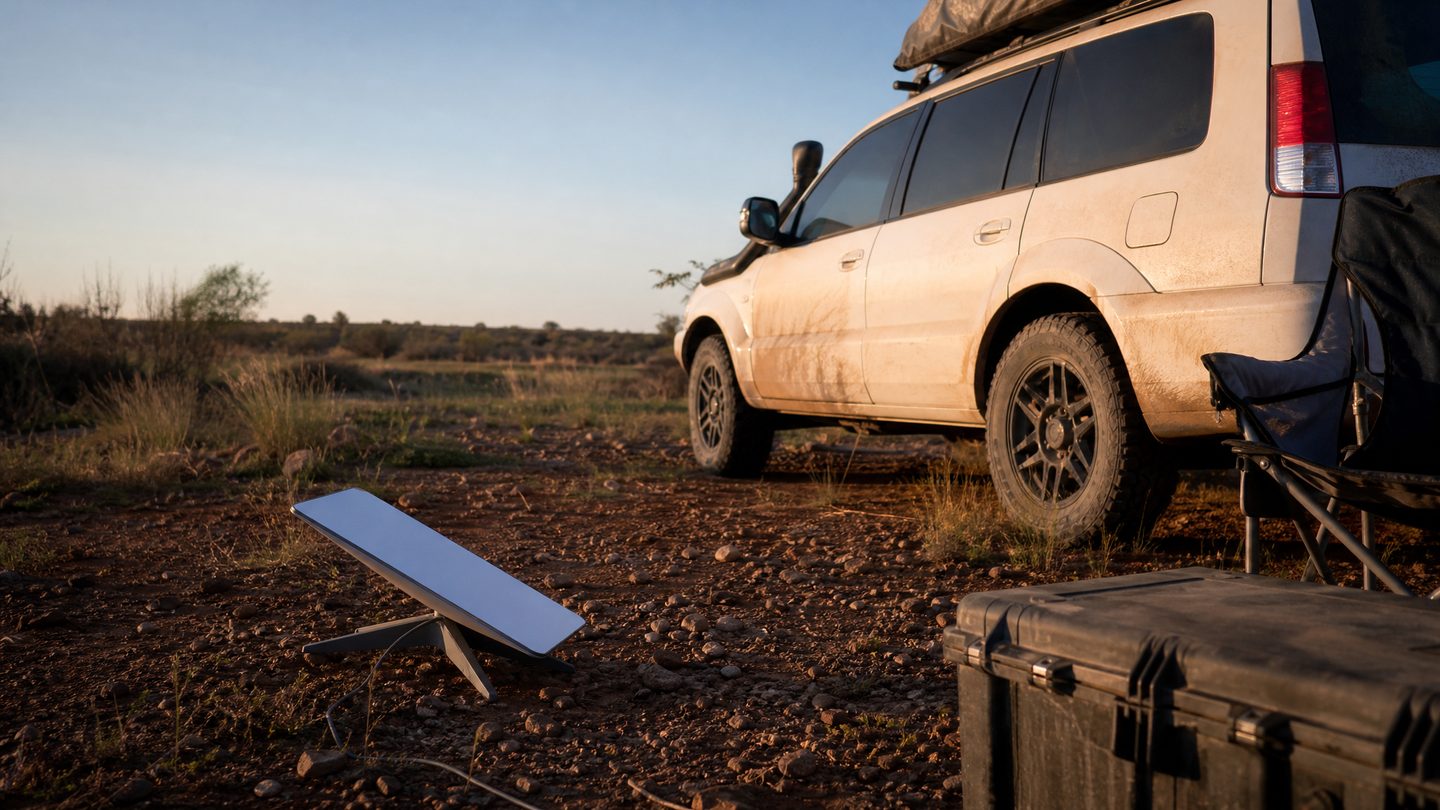
We hire Starlink out, so treat the conclusion here with the scepticism it deserves. The maths below is the same maths either way, and it does not always land on hiring.
Short version: for a trip of up to about three weeks, hiring is cheaper. Past that, buying wins, and it wins by more the more often you travel.
What buying actually costs
As at 24 September 2026, the Starlink website lists hardware from $289 in selected areas. Plans start at $75 a month for Residential 100 Mbps with unlimited data.
Two things people miss when they do this sum in their head:
Residential is probably not the plan you need. Residential is tied to a service address. If you are travelling, you want Roam: $85 a month for Roam 100GB, or $210 a month for Roam Unlimited. Priority costs more again. Those prices move, so check Starlink’s own site for the current figure rather than trusting a number in a blog post, including this one.
The plan is monthly, and you can pause it. That matters enormously for the maths. Someone who owns a dish and travels twice a year pays for the months they use, not twelve of them. Anyone comparing a one-off purchase against a one-off hire without accounting for pausing is comparing the wrong things.
What hiring costs
Our Starlink hire Perth page lists one plan, unlimited, priced by length:
| Hire length | Rate | Works out at |
|---|---|---|
| 7 to 13 days | $179/week | About $26/day |
| 14 to 24 days | $22/day | $22/day |
| 25+ days | $19/day | $19/day |
Plus a $300 refundable bond and a 10% deposit to hold the dates. Seven day minimum. No setup fee, no delivery charge, and nothing to cancel afterwards.
The break-even, worked out
Our hire kits come with unlimited data, so the fair comparison is Roam Unlimited. Buying costs $289 for the hardware plus at least one month of plan, so the cheapest like-for-like purchase is $499 before you have driven anywhere. That number does not change whether your trip is seven days or thirty.
| Trip length | Hire | Buy (hardware + plan) | Difference |
|---|---|---|---|
| 1 week | $179 | $499 | Hire saves $320 |
| 2 weeks | $308 | $499 | Hire saves $191 |
| 3 weeks | $462 | $499 | Hire saves $37 |
| 4 weeks | $532 | $499 | Buying wins by $33 |
| 6 weeks | $798 | $709 (2 months of plan) | Buying wins by $89 |
| 3 months | $1,710 | $919 (3 months of plan) | Buying wins by $791 |
So the crossover sits at roughly three weeks, on a single trip, on Roam Unlimited. If 100GB of fast data is enough for your trip, Roam 100GB makes the first month $374 and the crossover moves earlier, to about 17 days.
One quirk in our own pricing worth knowing
The day rate drops at 25 days, and the bands do not overlap neatly. A 24 day hire costs $528. A 25 day hire costs $475.
If your trip lands at 23 or 24 days, book 25 and pay less. We are not going to pretend that is elegant pricing, but you should know about it rather than find out afterwards.
What the table does not capture
You own the thing at the end. Four weeks of hire buys you four weeks. $499 buys you hardware you still have, which has resale value and which is there for the next trip. If there will be a next trip, that changes everything.
Owning has a setup cost that is not money. Ordering, waiting for delivery, activating the account, mounting it, learning the app, and dealing with it when something needs a firmware update the night before you leave. A hire kit is tested and handed over working. That is worth something to some people and nothing to others.
Hiring has no tail. No account to remember to pause, no dish in a cupboard depreciating, no subscription quietly renewing in March because you forgot.
Neither option solves a bad sky view. If you are camping under heavy canopy, the most expensive setup in the world still drops out. That is a placement problem, and we covered it in common Starlink setup issues.
So which one
Hire if: it is one trip, it is under about three weeks, you want it to work the moment you turn it on, or you are trying to find out whether satellite internet suits how you actually travel before committing $289 and a monthly plan to the question.
Buy if: you travel regularly, you are going for a month or more, you want it at home between trips, or you have a fixed rural property where the alternative is a bad NBN connection. At that point you are not comparing against a hire, you are comparing against your existing internet, and that is a different and much easier decision. Hardware is from $289 direct from Starlink if that is where you land.
Neither is right if you only need it near towns. Telstra covers more of regional WA than people expect, and a prepaid SIM in a hotspot is a fraction of both numbers above. Satellite earns its place once you are genuinely past the towers.
What you get either way
The hardware is identical. Our hire kits are the same Starlink Mini you would buy, and the speeds are the same speeds: the kits came back reading 180 Mbps from Esperance across summer and 175 Mbps from Exmouth in July, both handling 4K streaming and voice calls. The measured detail is in our notes on Starlink speeds in Perth and WA.
If you want to see exactly what is in a hire kit before you decide, we photographed everything that comes in the case.